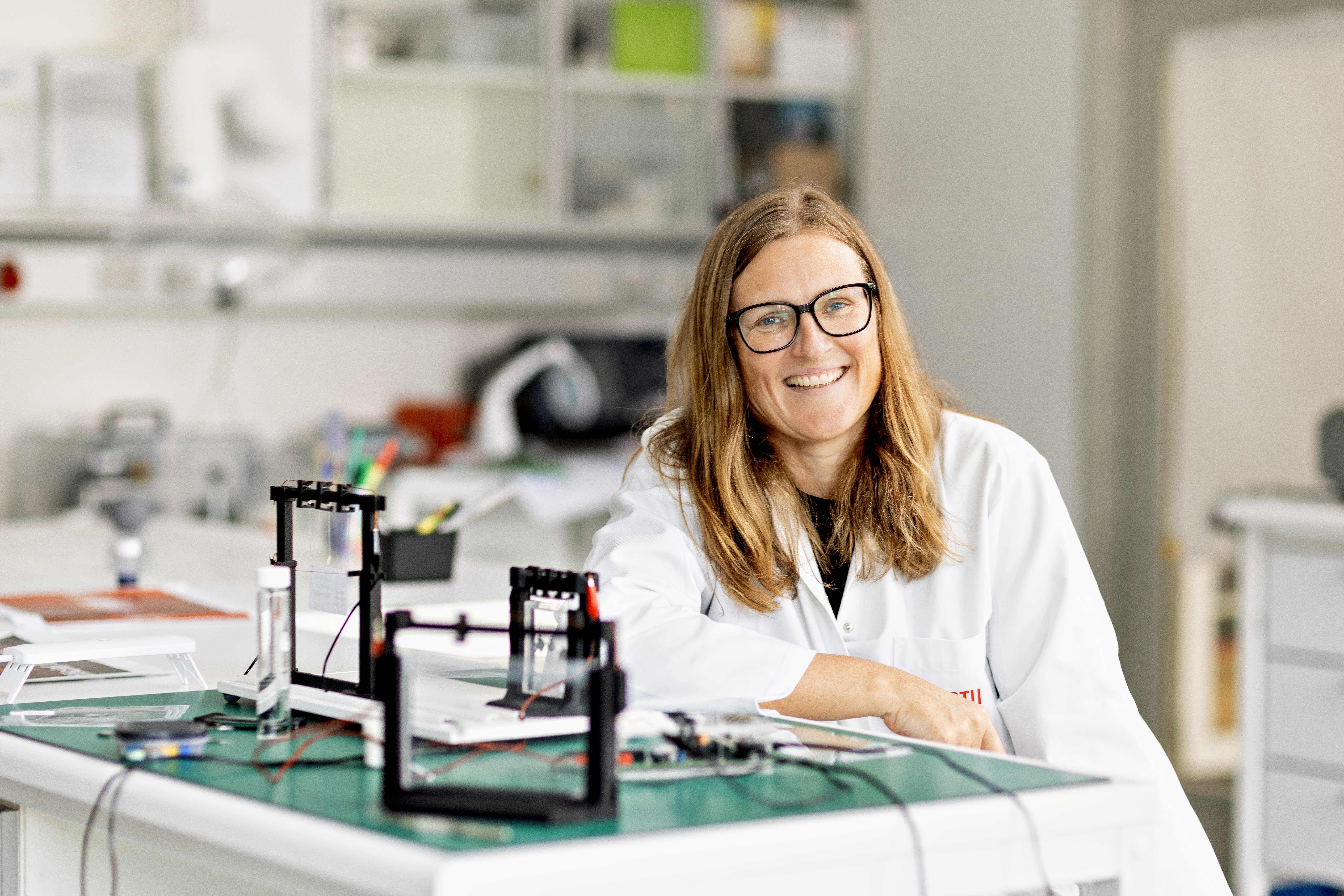
With support from the Innovation Fund, the start-up AleSac is developing a foam-based wound-treatment product designed to improve the treatment of deep, complex wounds.
Recipient of the 2026 Innovation Award: Anne Ladegaard Skov, co-founder of AleSac and professor and head of department at DTU Chemical Engineering. Photo: Thomas Steen Sørensen.
Thursday 01 October 2026
Magnus Stenaa Jensen
A caulking gun filled with silicone compound is set to enable doctors and nurses in the future to seal even deep wounds caused by blast injuries—thereby preventing amputations and reducing mortality among patients with severe wounds.
The start-up AleSac is working on this solution, which breaks with traditional wound care. A silicone compound is injected directly into the wound, where it expands into a soft foam that, amongst other things, removes wound fluid (exudate), which may contain harmful bacteria.
A prototype has been developed
The technology behind the wound foam stems from research at DTU. Building on this research, AleSac has developed a physical prototype and received funding from the Innovation Fund’s InnoExplorer programme for further development work.
The foam has particular potential in the treatment of severe traumatic wounds, including blast injuries and other complex injuries, where rapid and effective wound treatment can be crucial for saving tissue and avoiding amputations.
Furthermore, the technology could prove significant in crisis areas where patients cannot immediately receive advanced hospital treatment, and where managing infections is crucial to the healing process.
Foam that adapts to the wound
Deep and complex wounds can be difficult to treat with traditional wound care products. Many of these injuries consist of deep cavities with complex shapes, while the most advanced wound care products on the market today are typically flat plasters and dressings.
AleSac’s technology has been developed specifically to address this challenge. The silicone expands to form a soft foam that adapts to the geometry of the wound.
“We started with a simple question: Why do we treat deep wounds with flat products? Our technology is designed to fit the wound itself and create better conditions for managing complex wounds,” says Anne Ladegaard Skov, co-founder, professor and head of department at DTU Chemical Engineering.
In laboratory tests, AleSac’s antibacterial foam has been shown to be effective against multi-resistant bacteria in less than 120 minutes.
The liquid silicone mixture is injected directly into the deep wound using a caulking gun. Photo: AleSac
When the liquid comes into contact with the wound, it expands into a soft, mouldable foam that fills the entire wound cavity. Photo: AleSac.
The foam has two functions: 1. Absorption: Removes wound exudate, which can worsen the condition of the wound. 2. Antibacterial effect: The method inhibits bacterial growth, breaks down biofilm and can combat multi-resistant bacteria. Photo: AleSac.
From research to international medtech
AleSac has been accepted into the US medtech accelerator programme BioLab CATALYST.
“This acceptance is a significant milestone for AleSac. It gives us access to both unique regulatory expertise and a strong international network of investors, both of which can support our ambition to bring a new and effective wound treatment to patients in the US market,” says Anne Ladegaard Skov.
Throughout the accelerator programme, the start-up will gain access to specialist advice on European and US regulatory requirements, including the process leading up to future approval by the US Food and Drug Administration (FDA). This is an important step in the company’s ambition to eventually commercialise the solution in the US.
The Innovation Prize 2026
Every year, DTU awards the Innovation Prize to a researcher who demonstrates how excellent research can be translated into innovation—and benefit society.
This year’s recipient is Anne Ladegaard Skov.
She is a professor and head of department at DTU Chemical Engineering and is an internationally recognised researcher in the field of polymer technology—as well as a researcher who consistently works to ensure that knowledge is put into practice.
Alongside her research, Anne Ladegaard Skov has built up strong partnerships with industry, filed 19 notifications of inventions and is currently involved in two start-ups: Glysious and AleSac.